

Astana faces a 400,000 sq m warehouse shortage
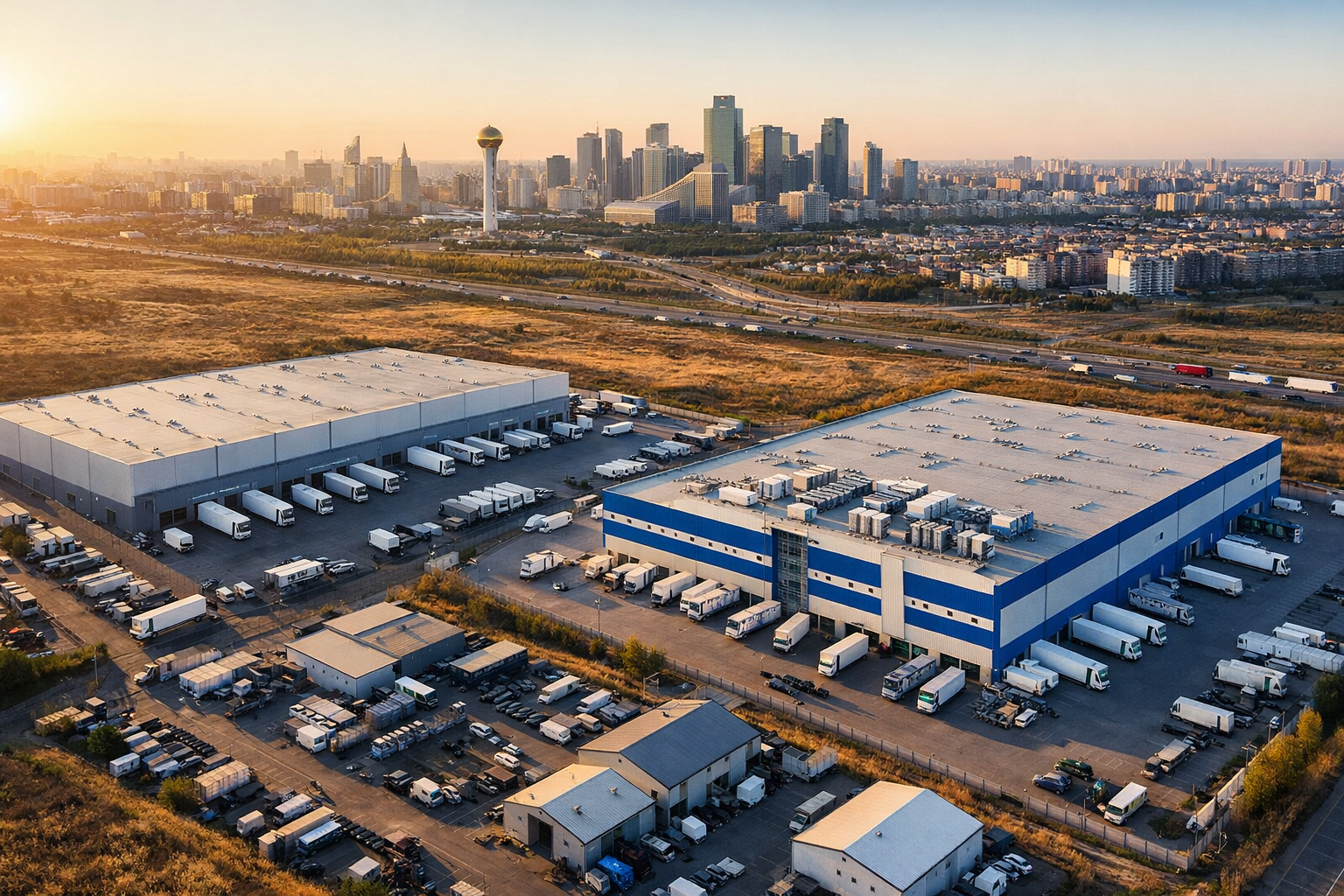
Astana’s warehouse real estate market is experiencing a significant shortage. According to the results of 2025, the capital accounts for 16.4% of Kazakhstan’s wholesale trade turnover, the second-largest share after Almaty. However, the city currently lacks sufficient high-quality warehouse infrastructure to support these flows.
At present, the agglomeration holds about 18.2% of the country’s modern warehouse stock (Class A and B facilities) — nearly three times less than Almaty. Market participants estimate the overall deficit of specialized formats at around 400,000 sq m, with the most acute shortages observed in urban warehouses, multi-temperature facilities, and light industrial space.
Macroeconomic growth drives demand
Kazakhstan’s GDP grew by 6.5% in 2025, while the transport and warehousing sector expanded by 20.4%. Real household incomes increased by 10.6%, and consumption rose by 11.7%. Consumer spending is increasingly shifting toward categories such as electronics, furniture, and clothing — goods that require warehouse infrastructure.
The country’s population has reached 20.5 million, with 64% living in urban areas and annual growth of about 200,000 people. Astana is experiencing the fastest population growth among Kazakhstan’s cities: by early 2026 the population exceeded 1.5 million residents, creating additional demand for logistics and warehouse facilities.
Russian companies also fuel demand
Another group driving demand for warehouse space is Russian businesses. Since 2022, Kazakhstan has become a key corridor for trade flows between Russia and external markets. Astana has emerged as a location where Russian companies establish legal entities, store goods, and process cargo, according to Stanislav Akhmedzyanov, Managing Partner at IBC Global.
According to Anton Loginov, Russia’s Trade Representative in Kazakhstan:
“Kazakhstan ranks among Russia’s top five trading partners. Last year, bilateral trade reached $27.3 billion, while Russian exports totaled a record $19.2 billion. The presidents of the two countries have set a goal to increase trade turnover to $30 billion in the near future, which will require further development of warehouse and logistics infrastructure.Currently, sectoral investment projects involving Russian companies worth more than $400 million are either underway or in development. Given the integration of the two economies and Kazakhstan’s role as a key logistics hub, further growth of the sector is expected.”
Second place with a large gap
Kazakhstan’s warehouse market remains a catch-up growth market. As of early 2026, the country’s modern warehouse stock (Class A+B) totals 2.21 million sq m. In 2025, the market expanded by 628,000 sq m.
Warehouse provision stands at only 0.107 sq m per capita, compared with 0.39 sq m in Russia, 4.4 sq m in Germany, and 4.8 sq m in the United States. This 4–40-fold gap represents not just underdevelopment but also a significant opportunity for growth.
Warehouse supply is also geographically concentrated:
- about 60% is located in the Almaty agglomeration
- around 18% in Astana
- about 22% in other regions
At the beginning of 2026, the total modern warehouse supply in the Astana agglomeration is estimated at around 400,000 sq m (Class A and B). Of this:
- dry warehouses (A+B) — 365,000 sq m, with a deficit of 350,000 sq m
- multi-temperature warehouses — only two complexes totaling about 35,000 sq m.
New projects
By 2027, multi-temperature warehouse supply is expected to increase to 41,000 sq m due to the commissioning of an 11,000 sq m facility within the A-Steel Asia logistics center in Astana’s Baikonyr district. Construction is scheduled for completion in 2026.
Nevertheless, the shortage of such facilities is estimated at about 80,000 sq m. Meanwhile, the light industrial segment currently has no modern supply, despite steadily growing demand.
Vacancy rates
The national warehouse vacancy rate stands at around 5%. According to IBC Global, the vacancy rate in Astana is even lower at approximately 3%.
Construction costs and rental rates
The construction cost of a Class A dry warehouse is around $667 per sq m.
In 2021, the figure was $460 per sq m, meaning costs have increased by 45% over four years.
Multi-temperature warehouses are significantly more expensive, ranging fr om $919 to $1,099 per sq m.
According to Dmitry Batenkin, Commercial Director at INGENIUM:
“Cost-cutting in cold-storage warehouse design does not reduce expenses — it increases risks. Selecting the wrong refrigerant may leave a facility without a functioning system, incorrect spacing of air-cooler fins can lead to icing and higher energy consumption for defrosting, and poor floor insulation may cause structural damage due to frost heave. Choosing a reliable contractor is therefore critical.”
Engineering infrastructure and energy supply account for 27.3% of total construction costs, making them a key area wh ere effective design and procurement strategies can deliver savings of 10–15%.
According to Roman Pak, Director for Central Asia at IBC Global:
“Astana has already reached a shortage of specialized warehouse formats. Demand is not limited to traditional big-box Class A facilities — tenants increasingly come with specific technical requirements: distribution warehouses, light industrial space for manufacturing, and urban warehouses for last-mile logistics.For the market to become balanced, it needs at least 500,000 sq m of new modern supply. Each year of delay means lower returns for developers and higher rental rates for tenants.”