

Logistics Infrastructure in Kyrgyzstan: No Warehouses, but Hang in There
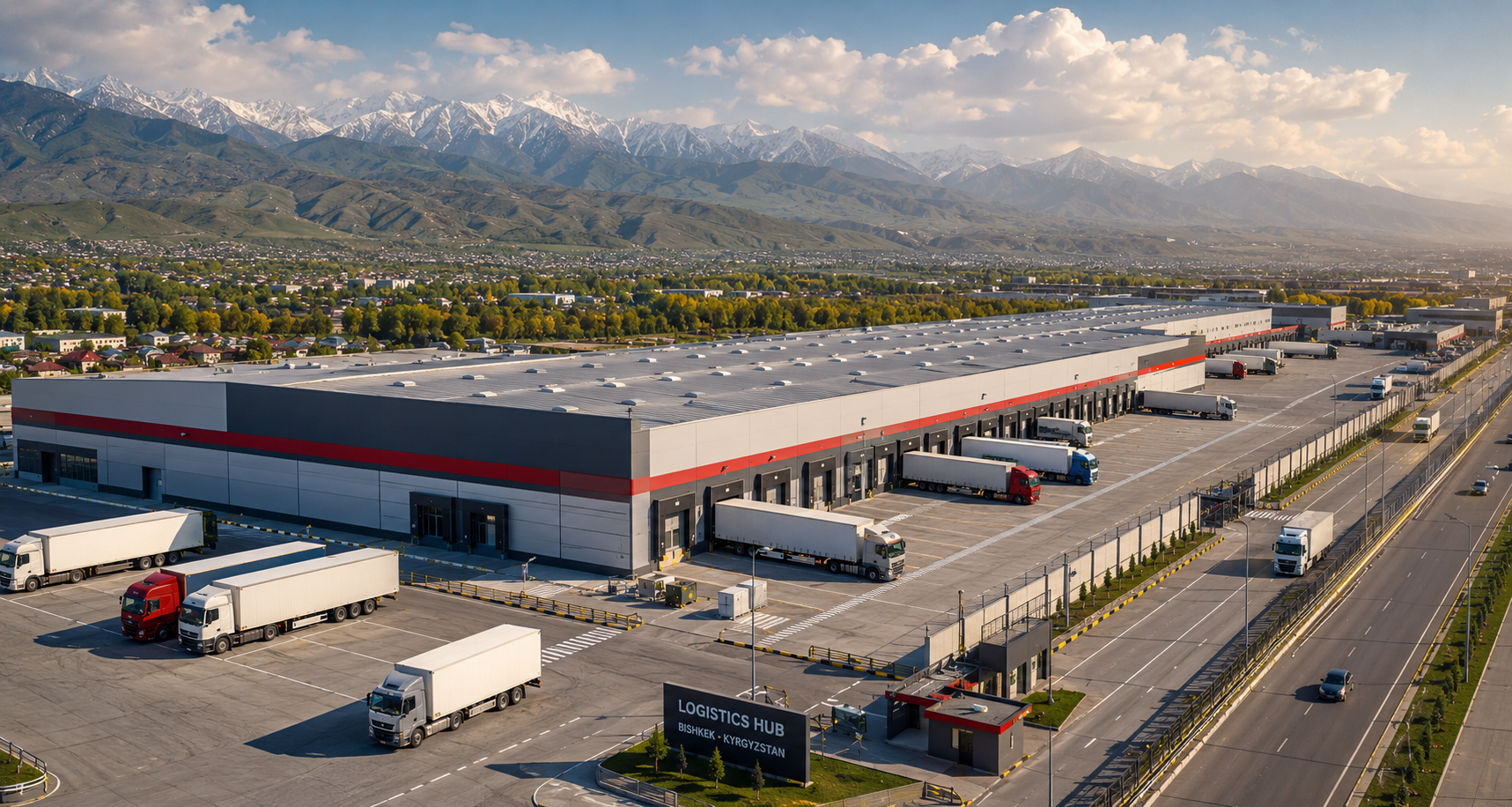
On May 21, a business breakfast organized by IBC Global took place at Hyatt Regency Bishkek, bringing together key players in Kyrgyzstan’s warehouse real estate and logistics market. The event was held to a full house — interest in the topic was so high that there were no seats left in the venue. Participants discussed the main issue: why the republic is facing a catastrophic shortage of high-quality warehouse infrastructure despite growing demand — and what can be done about it.
Bishkek occupies a special place in Central Asian logistics as a key transit hub for regional trade routes. However, according to data from IBC Global, the city’s warehouse stock — totaling 110,000 sq. m — is fully contracted, with vacancy in the Class A segment remaining at zero.
The total volume of existing quality warehouse infrastructure in Kyrgyzstan (Class A and B facilities) amounts to approximately 110,000 sq. m. Nearly all facilities are concentrated in Bishkek (around 90%), while only 36,000 sq. m belong to the Class A segment — effectively just one or two facilities.
“For the market, this volume is extremely insignificant and makes it vulnerable to any changes in the behavior of major tenants: the rotation of even one anchor resident can dramatically alter the vacancy picture. But most importantly, there is simply no available space for local or international companies to carry out logistics operations,” comments Roman Pak.
The situation in neighboring countries is only slightly better: Class A vacancy stands at 1.5% in Uzbekistan and 4.9% in Kazakhstan, while in Kyrgyzstan this indicator is effectively nonexistent. As a result, the country now has the highest rental rates in Central Asia — $14 per sq. m per month for Class A facilities (excluding OPEX and VAT), exceeding rates in Almaty ($10.6) and Tashkent (around $12.1).
With a population of 7.4 million people, Kyrgyzstan currently has only 0.015 sq. m of quality warehouse space per capita — one of the lowest indicators among comparable Central Asian markets.
By the end of 2028, an additional 174,000 sq. m is expected to be built and commissioned, mainly through large-scale projects. The most notable example is Global Hub by developer Alkanov Group — a multifunctional Class A customs and logistics center with a total area of 137,000 sq. m located 3 km from Bishkek, construction of which began in December 2024.
The project stands out for going beyond the standard warehouse format: in addition to dry warehouses and light industrial facilities, the complex will include multi-temperature zones operating at up to -24°C, vegetable storage facilities, Kyrgyzstan’s first GDP-certified Class A pharmaceutical warehouse, bonded warehouses, and a customs terminal.
The first phase — 57,000 sq. m — is scheduled for completion in 2026, while the second phase (75,000 sq. m) is planned for 2027.
Another major logistics project is also planned for construction — the “Manas” trade and logistics city in the village of Leninskoye, Alamudun District.
The growth of e-commerce, increasing domestic demand from retail chains, manufacturers, and logistics operators, as well as the active expansion of FMCG companies, are generating steady demand for modern warehouse formats with developed infrastructure. All these segments require Class A facilities — something the market currently lacks and is unlikely to fully satisfy even with the announced new supply.
“Ask anyone who has ever ordered goods from a marketplace in Kyrgyzstan: how long did delivery take? Two days? Four? Some waited two weeks. This is not a last-mile logistics problem — it’s a symptom of the fact that полноценный e-commerce practically does not exist here. There are no distribution centers, no fulfillment infrastructure. The entire online retail sector literally operates ‘from the warehouse shelf.’ Until quality warehouse infrastructure appears, there can be no real development of e-commerce in the republic,” explains Chyngyz Arkanov, Owner of Alkanov Group.
There is also strong demand for quality warehouse infrastructure from Kyrgyzstan’s agro-industrial sector. Currently, the industry operates with virtually no cold-chain infrastructure between farms and end markets: products are manually reloaded, transported in open trucks, and lose quality at every stage of the supply chain. Even export-oriented producers are forced to work under such conditions.
“Right now, we operate in a primitive format: produce from the fields is transferred from buckets into wooden boxes and then loaded into trucks — without any refrigeration throughout the journey from the field to the buyer. Along the way, the truck is opened to ventilate and remove carbon dioxide. At the same time, we are actively adopting the experience of our Californian colleagues — there, one farmer manages 250 hectares of strawberries with yields of 70 tons per hectare, while we are still at 10–15 tons. That is our role model. Kyrgyzstan has enormous agricultural potential — but it remains completely untapped because there is still no comprehensive approach to agrologistics. However, we plan to change that for the better,” concluded Tilek Toktogaziev, Chairman of the Berry Growers Association and former Minister of Agriculture of Kyrgyzstan.